
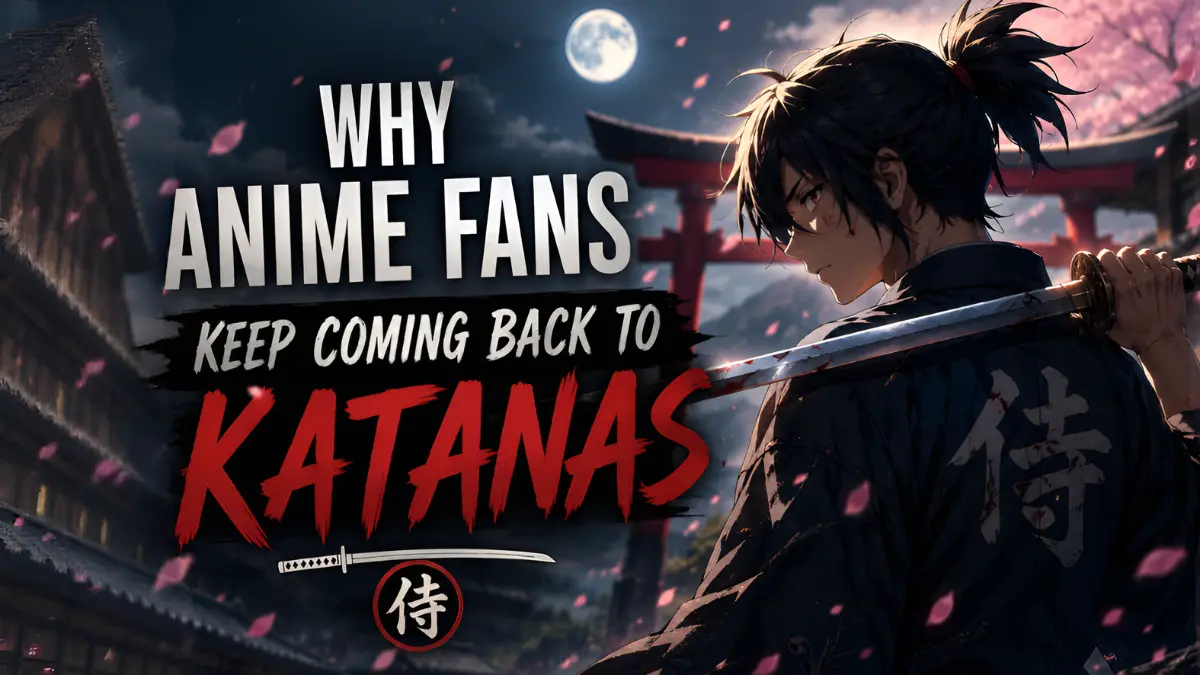
Every anime fan has at least one sword they remember. Maybe it is the black blade, the strange guard, the red wrap, or the scabbard that appears before the fight even starts. Maybe the character rests one hand on the hilt before a duel, or the camera cuts to the guard before the blade comes out. A good anime katana does not just sit in the character’s hand. It tells you what kind of story you are watching.
That is why the katana keeps showing up across so many genres. It works in historical anime, supernatural battle series, quiet revenge stories, and futuristic settings. The shape is familiar enough to read quickly, but flexible enough to carry a new mood each time.
The sword tells you who they are
Anime uses swords like character design shorthand. A plain black saya can make a character feel controlled and serious. A bright wrap can make the same basic shape feel younger or more volatile. A strange tsuba might hint at a clan, a power system, or a personal memory the show has not explained yet.
For fans who like breaking down sword designs, a katana customizer makes those choices easier to see. Change the handle color, guard shape, blade finish, or scabbard tone, and the sword suddenly feels like it belongs to a different type of character.
That is why fans argue about tiny design choices. A guard that looks too heavy can make a fast character feel wrong. A color that is too bright can change the mood of a serious scene. A clean white scabbard can make a character feel calm or untouchable, while a rougher dark design can make them feel dangerous before they say a word. Even viewers who do not know the names of the parts can feel when the sword fits.
Anime gets to cheat
Animation can push a katana far beyond real-world limits. Blades can glow, stretch, split, burn, or look far heavier than any person could use. A sword can leave light trails, carry a curse, or transform with the character’s emotions. Anime earns those exaggerations because style is part of the storytelling.
A real katana sword is usually quieter. It depends on proportion, balance, blade shape, handle control, and the way the fittings work together. That restraint is not a weakness. It is what keeps the design believable in the hand.
Fans who move from anime swords to real swords often notice this shift first. The most interesting real pieces are not always the loudest. They are the ones where the curve, wrap, tsuba, and saya all feel like they belong together.
That shift can be a surprise. In anime, a huge guard, glowing edge, or strange blade shape can look amazing because the camera controls every angle. In real life, the same idea can feel clumsy if it throws off the balance or makes the sword look top-heavy. A good real-world design usually takes the spirit of the anime idea and trims away the parts that only work on screen.
The little details stick
A memorable anime sword usually has one or two details that lock into your brain. It might be a black blade, a flower-shaped guard, a white scabbard, a red cord, or a handle pattern that shows up clearly whenever the character reaches for it.
Those details work because they are easy to remember. The viewer does not need a lecture on sword parts. They just need a silhouette and a few strong choices. The sword becomes part of the character’s outline.
Real-world collectors can learn from that. A katana-inspired design usually works better when it keeps one clear idea instead of trying to include every possible reference. Too many colors, symbols, and shapes can make the piece feel messy.
The easiest test is simple: would the sword still look good if nobody knew the reference? If the answer is yes, the design probably has enough strength on its own. If the sword only works because someone recognizes a character, it may feel less interesting once the novelty wears off.
Prop, display sword, or real blade?
Anime fans also need to be honest about what they actually want. A foam prop, a cosplay-safe replica, a decorative display sword, and a functional blade are different things. They may share the same general shape, but they do not belong in the same situations.
Foam and plastic props make sense for conventions, photos, and public events. Decorative swords belong on stands or walls. A sharp functional sword requires adult responsibility, safe storage, and awareness of local rules. It should not be treated as a costume accessory.
There is no shame in choosing the safer version. If the goal is cosplay, a safe prop is usually the better choice. If the goal is collecting, the buyer should think about display space, maintenance, and who can access the sword at home.
Borrow the mood, not the whole design
The best anime-inspired sword ideas usually start with a feeling, not a copy. Is the character calm and disciplined? Wild and loud? Old-fashioned? Tragic? The answer can guide the colors, fittings, and scabbard without recreating a copyrighted weapon exactly.
Try pulling out one or two design cues. Maybe the contrast is the important part. Maybe the round tsuba matters more than the blade finish. Maybe the whole idea is a dark saya with a clean wrap and very little decoration. Fewer choices often make the sword feel stronger.
This approach also makes the final piece more personal. Instead of owning a lookalike, the fan ends up with a sword that carries the same energy in a different way.
Anime can be the doorway
Plenty of fans first notice katanas because they look cool on screen. That is fine. A strong design is supposed to catch the eye. The fun gets deeper when a fan starts learning what the parts are called and why the real object feels different from the animated version.
Once you notice the curve, the wrap, the guard, and the scabbard, anime swords become more fun to look at too. You start seeing what the artist changed, what they exaggerated, and what they borrowed from real sword design.
That is the best path from fandom to appreciation. A favorite scene grabs your attention. The details keep it there.



Ren Akira is an anime news writer at AnimeBooth.com, reporting on anime release dates, movie announcements, official updates, and top anime recommendations. Specializing in isekai, fantasy, and seasonal anime, Ren delivers accurate, timely, and engaging news for anime fans around the world.